Corporate Social Responsibility (CSR) in India has grown into a powerful force, channeling billions of rupees annually into social development. With nearly ₹35,000 crore spent every year, India stands among the global leaders in structured corporate philanthropy.
However, beneath this impressive number lies a deeper question—is CSR truly creating meaningful impact, or is it just fulfilling compliance requirements?
This blog explores India’s top CSR companies, sector-wise spending patterns, geographical disparities, and the benchmarks that define real impact.
The Scale of CSR in India: Big Money, Bigger Questions
India’s CSR framework mandates eligible companies to spend 2% of their average profits on social initiatives. The result? A highly compliant system where over 98% of companies meet their CSR obligations.
Yet, despite this near-perfect compliance, the outcomes often fall short of expectations.
Why does this gap exist?
The answer lies in how CSR is approached. For many organizations, CSR is still seen as a legal obligation rather than a strategic opportunity to drive long-term social change.
Why Spending Alone Doesn’t Define Impact
Most CSR rankings traditionally reward companies based on how much they spend. But spending alone can be misleading.
A company investing heavily without a clear strategy may achieve limited results, while a smaller, well-planned initiative can deliver transformative outcomes.
To address this, a more effective evaluation framework considers three key dimensions:
1. Magnitude of Spend (30%)
How much money is being allocated toward CSR initiatives?
2. Strategic Alignment (30%)
Is the CSR activity aligned with the company’s core strengths and long-term goals?
3. Verifiable Impact (40%)
Are there measurable, transparent outcomes that demonstrate real change?
This shift from spending-focused evaluation to impact-driven analysis is crucial for understanding true CSR performance.
India’s Top 10 CSR Companies
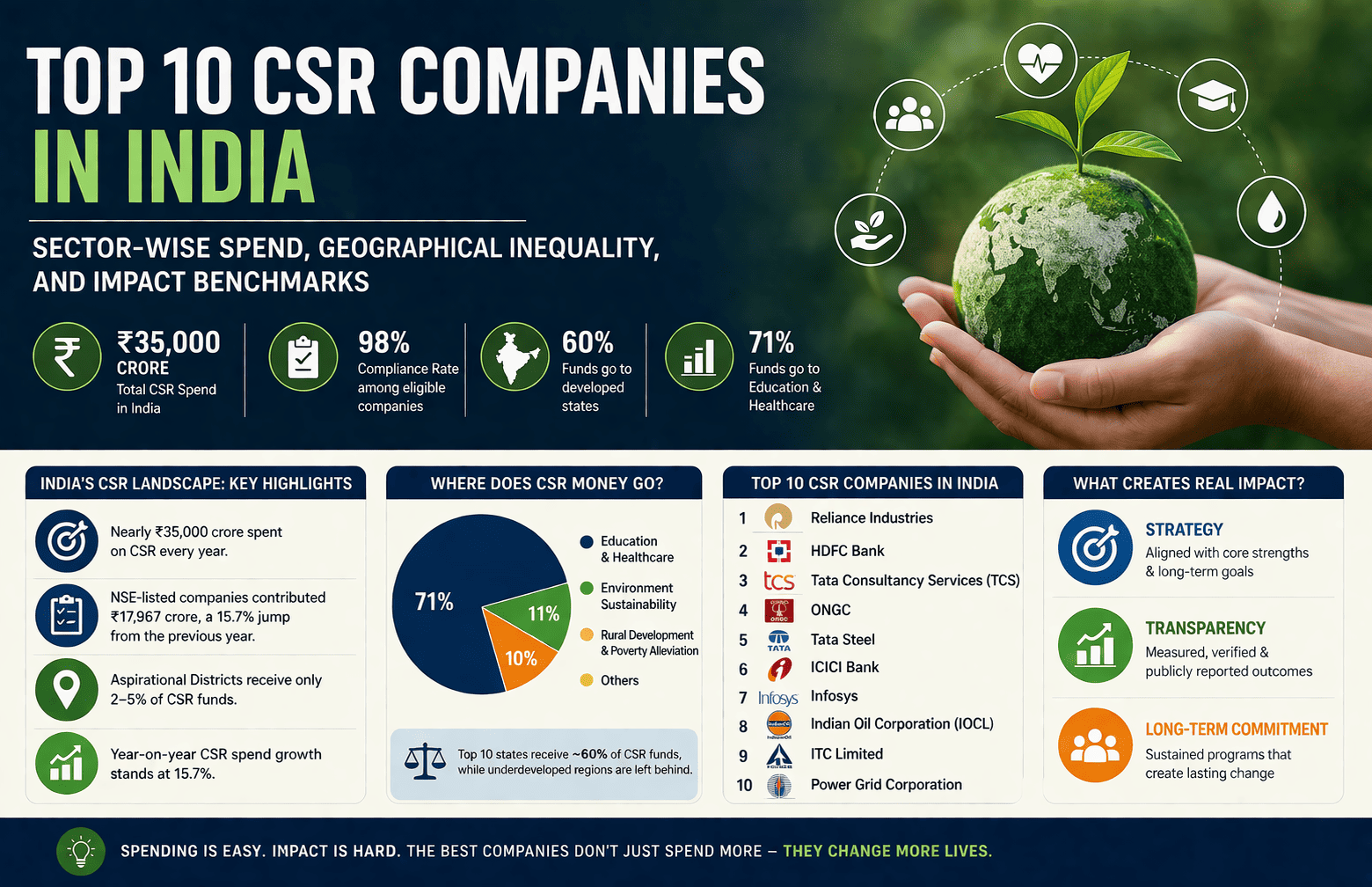
Based on a combination of spend, strategy, and impact, the following companies emerge as India’s top CSR contributors:
- Reliance Industries
- HDFC Bank
- Tata Consultancy Services (TCS)
- ONGC
- Tata Steel
- ICICI Bank
- Infosys
- Indian Oil Corporation (IOCL)
- ITC Limited
- Power Grid Corporation
These organizations represent a mix of industries—from banking and IT to energy and manufacturing—highlighting how CSR is embedded across sectors.
What Differentiates CSR Leaders?
While all top companies contribute significantly, the real differentiator lies in how they approach CSR.
Scale vs Depth
Some companies prioritize scale, reaching millions of beneficiaries through large programs. Others focus on depth, targeting specific regions with intensive, long-term interventions.
- Reliance Industries excels in scale, reaching tens of millions through technology-driven initiatives.
- HDFC Bank focuses on depth, particularly in rural and underdeveloped regions through its Parivartan program.
Both approaches are valuable—but depth often leads to more sustainable transformation.
Transparency and Measurement
One of the biggest challenges in CSR is measuring real impact.
- TCS stands out for its commitment to transparency, publishing third-party verified outcomes.
- Many companies, however, still rely on reporting activities rather than outcomes.
For example:
- Activity-based reporting: “We trained 10,000 individuals.”
- Impact-based reporting: “8,000 individuals secured employment.”
Only the latter demonstrates tangible success.
Strategic Alignment
Companies that align CSR with their business strengths achieve better outcomes:
- Banks focus on financial inclusion and rural development
- IT firms invest in digital literacy and education
- Energy companies support infrastructure and community development
This alignment ensures efficiency, scalability, and long-term sustainability.
Sector-Wise CSR Spending: The 71% Concentration
A major insight from the data is the heavy concentration of CSR spending in just a few sectors:
- 71% of funds go to education and healthcare
- Environmental sustainability receives about 11%
- Rural development and poverty alleviation receive significantly less
This concentration reflects a preference for “safe” sectors—projects that are easy to execute, measure, and showcase.
However, this approach leaves critical issues like climate resilience and rural poverty underfunded.
The Geography Problem: Unequal Distribution of CSR Funds
Perhaps the most concerning issue in India’s CSR ecosystem is geographical inequality.
Key Observations:
- Around 60% of CSR funds are concentrated in developed states
- Underdeveloped regions receive minimal funding
- Aspirational Districts—India’s most vulnerable areas—get only 2–5% of CSR funds
This imbalance means that CSR is often reinforcing existing inequalities rather than reducing them.
Why Does This Inequality Exist?
The answer lies in Section 135 of the Companies Act, which encourages companies to prioritize spending in areas where they operate.
While this seems practical, it leads to unintended consequences:
- CSR funds cluster in industrial and urban regions
- Remote and high-need areas remain underserved
From a business perspective, local spending is:
- Easier to manage
- More cost-effective
- Lower risk
But from a societal perspective, it limits CSR’s transformative potential.
Case Study: HDFC Bank vs Reliance Industries
A comparison between two leading CSR players highlights contrasting approaches:
HDFC Bank – The Deep Integration Model
- Focuses on rural development
- Works across multiple sectors (water, livelihoods, education)
- Targets Aspirational Districts
- Creates long-term, systemic impact
Reliance Industries – The Scale Model
- Builds large, tech-enabled platforms
- Reaches millions across the country
- Focuses on wide outreach
Key Takeaway:
- Depth creates transformation
- Scale creates reach
The ideal CSR strategy often combines both.
What the Data Reveals: Progress and Gaps
Encouraging Trends:
- High compliance across companies
- Increasing CSR spending year-on-year
- Strong participation from diverse industries
Key Challenges:
- Geographic concentration of funds
- Limited focus on high-need sectors
- Lack of standardized impact measurement
These gaps highlight the need for a shift toward intentional and outcome-driven CSR.
The Impact Gap: Measuring What Matters
One of the most critical shortcomings in CSR today is the lack of robust impact measurement.
Most companies report:
- Number of beneficiaries
- Number of programs conducted
But fewer report:
- Long-term outcomes
- Behavioral or economic changes
- Third-party verified results
This creates an “impact gap”, where activities are visible but real change remains uncertain.
What Needs to Change in India’s CSR Ecosystem
To unlock CSR’s full potential, several changes are necessary:
1. Shift from Compliance to Impact
CSR should focus on solving real problems, not just meeting legal requirements.
2. Improve Geographic Equity
More funds must be directed toward underdeveloped and high-need regions.
3. Invest in Long-Term Programs
Sustainable impact requires multi-year commitments, not one-off projects.
4. Strengthen Transparency
Third-party verification and public reporting should become standard practice.
5. Policy-Level Reforms
Incentives should encourage companies to invest in underserved areas.
The Road Ahead: From Spending to Transformation
India’s CSR landscape is at a turning point.
While the country has successfully built a robust compliance-driven system, the next phase must focus on impact, equity, and sustainability.
The companies that will lead this transformation are not necessarily those that spend the most—but those that:
- Think strategically
- Measure rigorously
- Commit long-term
- Focus on real outcomes
Conclusion
CSR in India has immense potential to drive inclusive growth and address some of the country’s most pressing challenges. But to realize this potential, the focus must shift from “how much is spent” to “what difference is made.”
Until then, CSR risks remaining a story of high expenditure with limited transformation.
The future lies in building a system where compliance and consequence go hand in hand, ensuring that every rupee spent creates measurable, lasting impact.